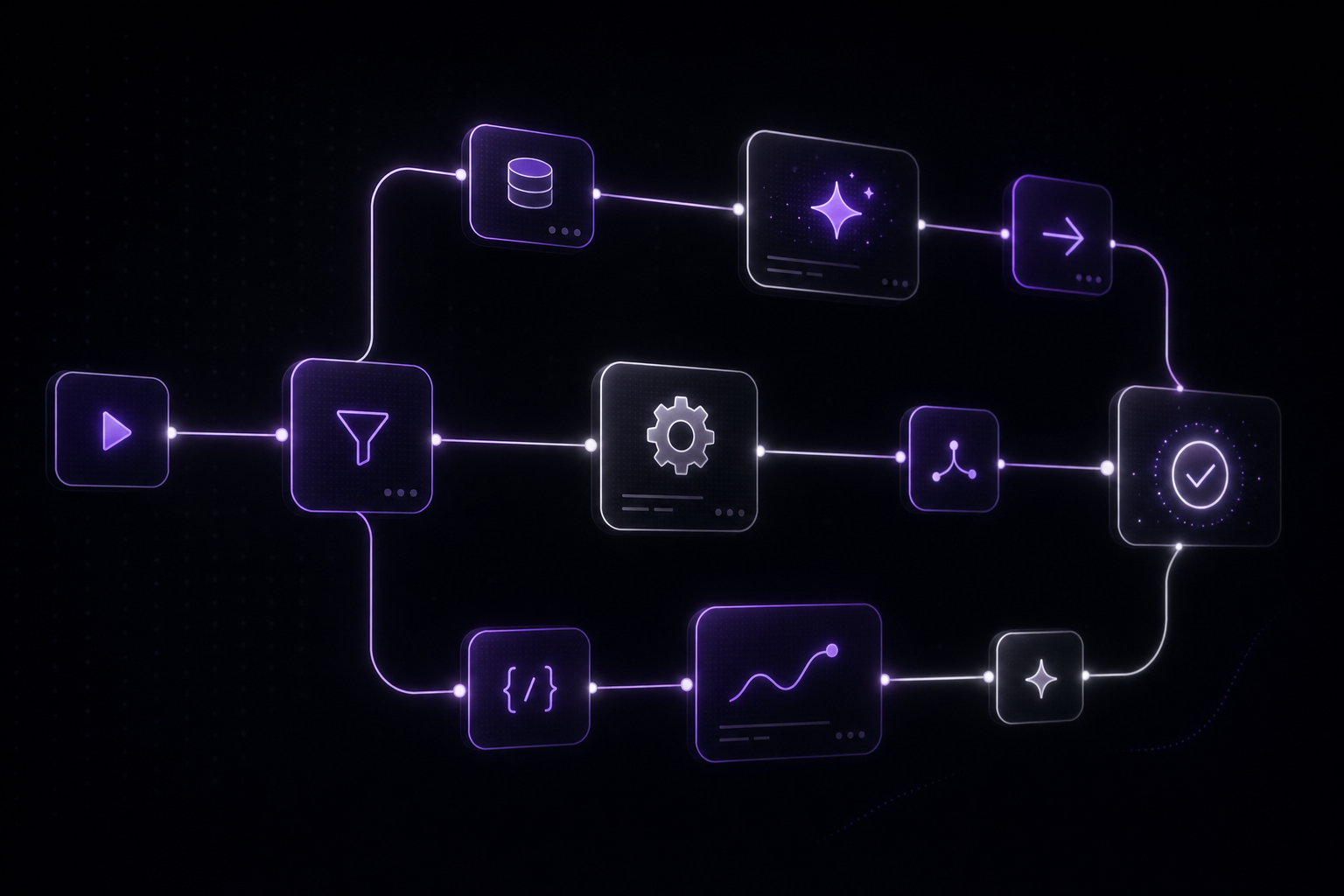
What Is Agentic Orchestration?
Agentic orchestration lets AI agents coordinate, reason, and act across multiple models and tools. Learn how it works and why it matters.

The phrase "agentic orchestration" keeps showing up in AI conversations, but most explanations either oversimplify it or bury the concept under layers of jargon. Here is what it actually means and why it is becoming the foundation for serious AI work.
From single prompts to coordinated agents
Early AI applications followed a predictable pattern: send a prompt, receive a response, repeat. That works fine for simple tasks like summarizing text or answering a question. But real-world problems rarely fit into a single prompt-response cycle.
Consider building a product description pipeline. You need one model to analyze product specs, another to generate marketing copy, a third to extract SEO keywords, and a quality check to verify accuracy. Each step depends on the output of the previous one. Some steps run in parallel. Others need conditional logic: if the product is a food item, include nutritional claims; if it is electronics, emphasize technical specifications.
This is where orchestration comes in. Instead of writing code to chain API calls together, you define a workflow where each AI model acts as a specialized agent with a specific role. The orchestration layer manages how these agents communicate, what data flows between them, and what happens when something goes wrong.
What makes it "agentic"
The word "agentic" distinguishes this from simple sequential pipelines. An agentic system has three properties that static pipelines lack:
Decision-making. Agents can evaluate their own output and decide what to do next. A content generation agent might assess confidence in its output and route low-confidence results to a human reviewer while passing high-confidence results straight to publishing.
State awareness. The orchestration layer maintains context across the entire workflow. Each agent knows what happened before it, what other agents are doing in parallel, and what the overall goal is. This is fundamentally different from stateless API calls.
Adaptive routing. Workflows can branch, loop, and recover. If an image generation model produces a result that fails a quality check, the system can automatically retry with adjusted parameters or fall back to an alternative model. No manual intervention required.
How orchestration actually works
At the technical level, agentic orchestration involves a few core components:
A workflow graph. Each node represents an operation: calling an AI model, transforming data, making a decision, or interacting with an external API. Edges define the flow of data between nodes. This graph can include parallel branches, conditional paths, and feedback loops.
A state machine. The orchestration engine tracks where each execution is in the workflow, what data is available at each point, and what transitions are valid. This is what enables the "agentic" behavior: nodes can inspect the current state and make decisions based on accumulated context.
Model abstraction. A good orchestration system decouples the workflow logic from specific model providers. You define what you need (image generation, text analysis, speech synthesis) and the system handles the API calls, error handling, and format conversion for whichever model you choose.
Execution management. Running multiple AI models in parallel, managing rate limits, handling timeouts, tracking costs, and logging results. The orchestration layer handles all of this so you can focus on the workflow logic.
Why this matters now
Three trends are converging to make agentic orchestration essential:
Model specialization. The era of one model doing everything is ending. The best image model is not the best text model, and neither is the best audio model. Real applications need to combine specialists, not rely on generalists.
Rising complexity. AI use cases have moved beyond simple chatbots. Companies are building AI-powered supply chains, automated content factories, and intelligent customer service systems. These require coordinated multi-step workflows, not one-off API calls.
Cost optimization. Sending everything to the most expensive model is wasteful. Orchestration lets you route simple tasks to lightweight models and reserve expensive ones for where they add the most value. A well-orchestrated pipeline can cut token costs by 60-80% compared to running everything through a single premium model.
What this looks like in practice
Here are concrete examples of agentic orchestration in production:
Content production pipeline. A media company uses orchestration to generate, edit, and publish articles. One agent researches the topic using web search APIs. Another drafts the article using a language model. A third generates accompanying images. A fourth handles SEO optimization. A quality agent reviews everything before a human editor does the final pass. The entire pipeline runs in under three minutes per article.
[3D asset generation](/ai-3d-content-creation). A VFX studio orchestrates multiple AI models to generate 3D content. Text descriptions feed into an image generation model, which produces reference images. Those images flow into a 3D reconstruction model. The resulting mesh gets passed to a texturing agent. Finally, a quality assessment agent checks the output against the studio's technical requirements. What used to take a 3D artist two days now takes fifteen minutes of compute time.
Customer support automation. An e-commerce platform routes customer messages through a classification agent that determines intent, urgency, and complexity. Simple queries (order status, return policy) go directly to a response generation agent. Complex queries get enriched with customer history data before reaching a more capable model. Escalation triggers route to human agents with full context already assembled.
Building vs. coding orchestration
You can build agentic orchestration in code. Many teams do, stitching together LangChain, custom scripts, and API wrappers. It works, but it creates maintenance headaches. Every model update requires code changes. Debugging a multi-step workflow means reading logs line by line. Changing the flow means refactoring application logic.
Visual orchestration platforms offer an alternative. You design workflows on a canvas, connect nodes with typed data ports, and deploy the result as an API endpoint. The orchestration logic is visible and editable without touching code. When a model provider releases a new version, you swap one node. When business requirements change, you rearrange the canvas.
This is not about whether engineers can write code. They obviously can. It is about whether coding is the most efficient way to build, test, iterate on, and maintain AI workflows that change frequently and involve multiple non-technical stakeholders.
Where this is heading
Agentic orchestration is still early. Most organizations are experimenting with simple two or three step pipelines. But the trajectory is clear: AI applications will increasingly be composed of multiple specialized agents working together, not monolithic models trying to do everything.
The companies that figure out orchestration first will have a structural advantage. They will iterate faster, combine models more effectively, and adapt to new capabilities as they emerge. The companies that keep building one-off integrations will spend more time maintaining infrastructure than building products.
The question is not whether you need agentic orchestration. It is how soon you start building with it.